Health data
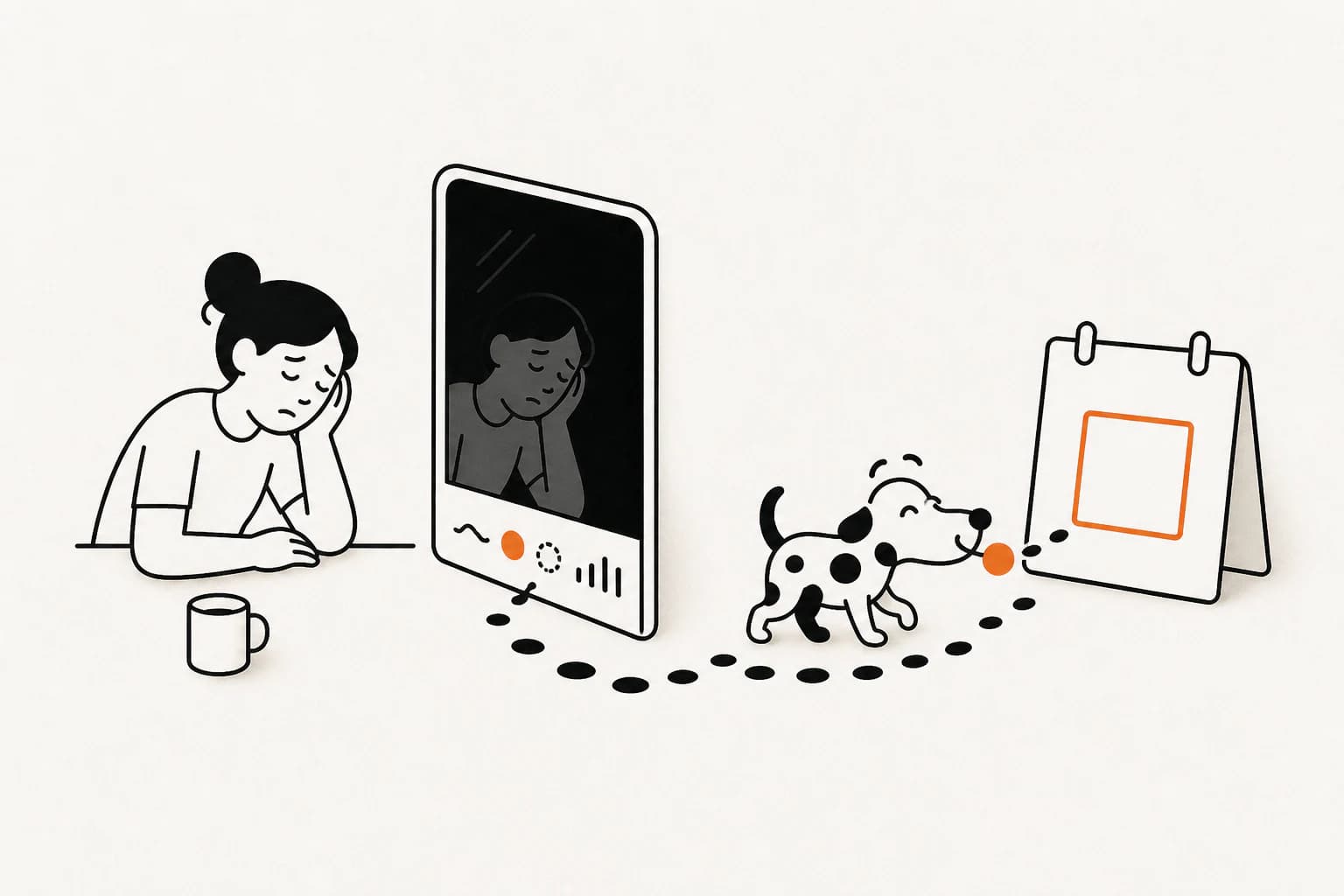
Your health app is a mirror.Mirrors do not catch you.
Your wearable already knows when the day is too heavy. The missing part is an agent willing to act.

By Waldo team
Product and health systems
Listen
Loading audio · System voice
On this page
You wore something on your wrist all night. It measured your heart, your breathing, how long you spent in each stage of sleep, how much you moved. A steady stream of data, collected from your own body, while you were unconscious.
In the morning it gave you a number.
You looked at the number, felt briefly bad about it, and then did exactly what you were already going to do. The calendar was packed, and the number does not attend meetings.
That is the whole industry. We built the most intimate measurement apparatus in human history and then handed people a score and walked away.
Advice is not care#
Open almost any health app after a bad night and you will get some version of the same advice: go to bed earlier, drink water, try to reduce stress.
Thank you. Genuinely. I had not considered sleeping.
That advice is not wrong, it is just unattached to anything. It does not know you have a board call later. It does not know that the same difficult Tuesday keeps following the same kind of Monday. It does not know that when you skip lunch your afternoon falls apart, because it has never once looked at your afternoon.
Generic advice is what you give someone when you do not know them. Which is fair, because it does not.
The gap that matters is not between what you know and what you should do. Most people know they should sleep more. The gap is between what your calendar thinks you can do and what your body can actually sustain today. Nobody is standing in that gap.
What noticing looks like#
There is a difference between measuring you and paying attention. It comes down to what gets remembered.
Measuring is a reading. Paying attention is a reading compared against every other reading, over months, until shapes appear.
Some shapes are obvious once someone points at them:
Your HRV drops on the mornings after late screen time. Not every time. Consistently enough to be worth saying out loud.
You kept sending messages long after the day should have ended. Sleep efficiency was lower the next morning. Those two facts may be related and nobody was holding both of them at once.
Back-to-back Tuesdays with no protected window. That is not weather. That is a decision you keep making without noticing you are making it.
The rest days you felt guilty about produced your fastest recovery of the period. Which is annoying, because you felt guilty about taking them.
None of that is advice. It is just something true about you that was sitting in data you already owned, unread.
Where to push and where to stop#
Every serious athlete has a coach for one reason, and it is not motivation. It is that you are a bad judge of your own capacity in both directions.
On a rough morning, you may have more in the tank than it feels like. On a day when you feel invincible, you may already be running on the last of it. Your own read is noisy. Your physiology adds another signal.
This is why "listen to your body" is such useless advice on its own. Your body is not speaking English. It is emitting heart rate variability, resting heart rate, sleep architecture, and recovery slope, and those signals need interpretation before they can inform the day.
Push on the good days. Bank the hard sessions and the hard conversations for when your system can take them. Stop on the bad ones, actually stop, not "take it easy" while doing everything anyway. Most people do the opposite, because most people schedule by calendar availability rather than by capacity, and the calendar does not know that Thursday is going to be rough.
Coming to you, not waiting for you#
Industry retention benchmarks show the same basic problem: most people stop returning to health and fitness apps within the first month.
The reason is not that people stopped caring about their health. The reason is that a screen requires you to remember it exists, open it, interpret it, and then act, several separate acts of willpower before anything happens. That is a lot to ask first thing in the morning.
Anything that waits to be opened will eventually stop being opened.
So the thing has to come to you. Not with a notification showing another score, which is the same mirror in a smaller frame. With something that already happened, and a reason.
What we built#
Waldo reads your body through the wearable on your wrist and your day through the tools you already use. Then it acts on the distance between them.
In practice, The Brief tells you what kind of day your body has prepared for and what Waldo already adjusted. The harder meeting moves to an hour when you are actually sharp. The one that could have been async becomes async. If stress keeps climbing in the afternoon, Waldo says so before you have quite registered it yourself.
Rough night, so it cleared the morning and pushed the first meeting later. That is the shape of it. It tells you the reason, it leaves you the undo, and then it stops talking. There is no streak. There is no encouragement. Waldo does not think you have got this. Waldo thinks there is a meeting you should not take today.
It also stays quiet most of the time, which turns out to be the hardest feature to build and the one people notice second.
Here is the honest limit: none of this arrives fully formed. Waldo starts with broad reference points and a polite guess. Your own baselines need time, and patterns need repeated days to compare. Anything that claims to know you in an afternoon is describing a demo.
The chart shows you what happened. That is the entire job it was designed for, and it does it well. We just think somebody should be doing something about what happens next.
Sources and basis
Waldo team
The team working on how wearable signals become careful, inspectable actions in an ordinary day.